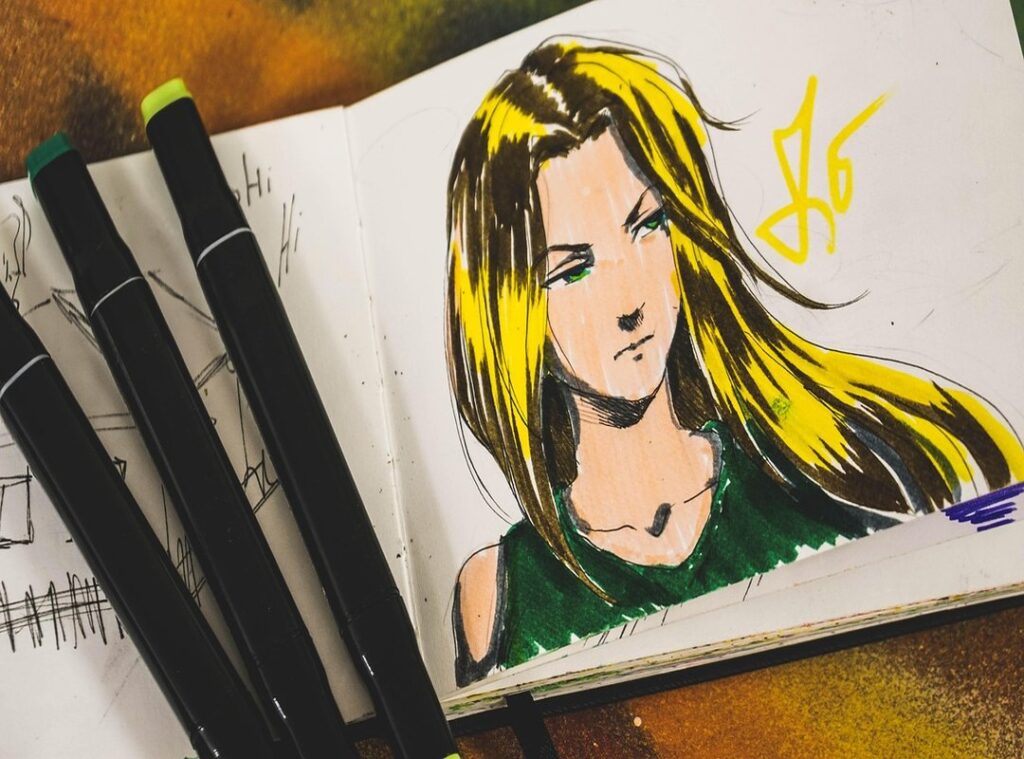
Anime art is captivating, and I get it—you want to create your own. This article will break down how to create a sketsa lukisan anime simple into easy, manageable steps. You don’t need fancy tools or years of experience.
By the end of this guide, you’ll have sketched your first anime face and feel confident to keep practicing. We focus on simple, foundational techniques that deliver great results for beginners. Trust me, you can do this.
What Makes a Sketch Look ‘Anime’?: Core Principles for Beginners
Large, Expressive Eyes
The most critical element in making a sketch look anime is the eyes. They are large and expressive. The shape, pupil size, and highlights all work together to convey emotion.
For example, larger pupils can indicate happiness or surprise, while smaller pupils might suggest anger or fear.
Simplified Facial Features
Other facial features are often simplified. A small, simple nose (often just a dot or a small line) and a minimalist mouth. This keeps the focus on the eyes and the overall expression.
Unique Approach to Hair
Hair in anime is different too. Instead of drawing individual strands, you create large, defined clumps or ‘spikes’. This gives the hair a more dynamic and stylized look.
Think about how you see hair in popular anime shows; it’s not realistic but it’s very distinctive.
Basic Head Shape and Proportions
The head shape in anime is also unique. You’ll notice a rounded face with a pointed chin. These proportions help to create that iconic anime look.
It’s quite different from realistic portrait drawing, where the face is more elongated and the features are more detailed.
Comparative Point
To really understand the style, compare it to realistic drawing. In realistic portraits, the eyes are proportionate, the nose and mouth are detailed, and the hair is drawn strand by strand. In sketsa lukisan anime simple, the simplification and exaggeration of features make the art stand out.
Pro tip: Start with a basic oval shape for the head, then add the pointed chin. This will give you a good foundation to build on.
Gathering Your Gear: The Only Art Supplies You Really Need
When you’re just starting out, it’s easy to get overwhelmed by the sheer number of art supplies out there. Trust me, I’ve been there. But here’s the deal: you don’t need a ton of fancy gear to create great art.
Let’s start with pencils. For beginners, I recommend an HB pencil for initial light sketching. It’s perfect for getting your basic shapes and lines down without committing too much.
Once you’re happy with your sketch, switch to a 2B or 4B pencil for adding those darker, final lines. These pencils give you the right amount of darkness and control.
Now, let’s talk erasers, and a kneaded eraser is a must-have. It’s like a little magic tool that can lift graphite off your paper without damaging it.
On the other hand, a vinyl eraser is great for when you need to make sharp, clean removals. Both have their place, but I find myself reaching for the kneaded one more often.
Paper choice is another big decision. Here’s my take: a basic, smooth-surface sketchbook is all you need. Save the expensive, textured paper for when you’re more experienced.
Simple sketching doesn’t require anything fancy.
A few optional tools can be helpful, too. A fine-liner pen is great for inking the final sketch, giving it a clean, professional look. And if you want to add some soft shading, a blending stump is your friend.
It helps you achieve smooth transitions and adds depth to your work.
Remember, the key to mastery isn’t in owning the most expensive equipment. It’s in practicing with what you have. So, grab your HB and 2B pencils, a couple of erasers, and a simple sketchbook.
Start with a sketsa lukisan anime simple and see where it takes you. sketsa lukisan anime simple
Your First Drawing: A Step-by-Step Guide to a Simple Anime Face

Let’s dive right in. You’re about to create your very first sketsa lukisan anime simple. It’s not as hard as you might think, and the results can be pretty rewarding.
First things first, and start with the foundation. Draw a circle for the top of the head.
Then, add the jawline and a pointed chin below it. This basic shape will give you a solid starting point.
Next, add construction lines. Draw a vertical line down the center of the face and a horizontal line across the middle. These lines will help you place the features evenly.
Now, sketch the eyes. Place large, almond-shaped eyes on the horizontal guideline. Make sure they are evenly spaced.
This step is crucial for that classic anime look.
Place the nose and mouth. Add a small, simple nose just above the point where the jawline circle ends. Below it, draw a simple line for the mouth.
Keep it minimal; less is more here.
Block in the hair. Draw the hairline and then add large, flowing shapes for the bangs and sides. Emphasize movement and form over detail.
This will give your character a dynamic, lively appearance.
Finally, refine and darken. Erase the initial guidelines and go over the final lines with a darker pencil. This will make your sketch pop and give it a clean, professional look.
By following these steps, you’ll end up with a simple yet impressive anime face. It’s a great way to build your drawing skills and gain confidence. Plus, you’ll have a cool piece of art to show for your efforts.
Avoiding Beginner Pitfalls: Quick Fixes for Common Sketching Errors
You might think guidelines are a waste of time. But trust me, they’re crucial, and wandering eyes can ruin a sketch.
Guidelines help keep features aligned correctly.
Some argue that pressing hard with the pencil gives a bold look. True, but it also makes erasing mistakes nearly impossible. Light strokes are your friend in the early stages.
- Use guidelines to align features.
- Press lightly with the pencil.
- Keep details minimal.
Overcomplicating the sketch is another common mistake. Adding too much detail, like individual eyelashes or hair strands, can detract from the sketsa lukisan anime simple style. Simple is often better, especially for beginners.
Incorrect proportions are a big no-no. A short forehead or a long chin can make your sketch look off. Again, guidelines are your best bet here.
They help you get the proportions right from the start.
So, while some might disagree, these quick fixes can save you a lot of frustration.
From Blank Page to Finished Sketch: Your Artistic Journey Starts Now
Creating a simple anime sketch is about understanding basic shapes and proportions, not complex techniques. This approach makes the process accessible and enjoyable for beginners. You’ve found the answer to how to create a sketsa lukisan anime simple with an actionable, step-by-step process.
Embrace making mistakes; they are a crucial part of the learning process. Grab a pencil and paper now and follow the steps to create your first sketch immediately after reading.

 Carolety Graysons is the kind of writer who genuinely cannot publish something without checking it twice. Maybe three times. They came to women's empowerment news through years of hands-on work rather than theory, which means the things they writes about — Women's Empowerment News, Women in Leadership Profiles, Fashion and Style Tips, among other areas — are things they has actually tested, questioned, and revised opinions on more than once.
That shows in the work. Carolety's pieces tend to go a level deeper than most. Not in a way that becomes unreadable, but in a way that makes you realize you'd been missing something important. They has a habit of finding the detail that everybody else glosses over and making it the center of the story — which sounds simple, but takes a rare combination of curiosity and patience to pull off consistently. The writing never feels rushed. It feels like someone who sat with the subject long enough to actually understand it.
Outside of specific topics, what Carolety cares about most is whether the reader walks away with something useful. Not impressed. Not entertained. Useful. That's a harder bar to clear than it sounds, and they clears it more often than not — which is why readers tend to remember Carolety's articles long after they've forgotten the headline.
Carolety Graysons is the kind of writer who genuinely cannot publish something without checking it twice. Maybe three times. They came to women's empowerment news through years of hands-on work rather than theory, which means the things they writes about — Women's Empowerment News, Women in Leadership Profiles, Fashion and Style Tips, among other areas — are things they has actually tested, questioned, and revised opinions on more than once.
That shows in the work. Carolety's pieces tend to go a level deeper than most. Not in a way that becomes unreadable, but in a way that makes you realize you'd been missing something important. They has a habit of finding the detail that everybody else glosses over and making it the center of the story — which sounds simple, but takes a rare combination of curiosity and patience to pull off consistently. The writing never feels rushed. It feels like someone who sat with the subject long enough to actually understand it.
Outside of specific topics, what Carolety cares about most is whether the reader walks away with something useful. Not impressed. Not entertained. Useful. That's a harder bar to clear than it sounds, and they clears it more often than not — which is why readers tend to remember Carolety's articles long after they've forgotten the headline.